Krystal CK LEE
Surveillance of HIV/AIDS has traditionally relied on case finding to track morbidity and mortality. As the epidemic evolves, new mechanisms have been added to national programmes. The second generation HIV surveillance introduced at the turn of this century calls for activities tailored to the epidemic context and which informs prevention decision.1 For countries with concentrated or low level epidemic (definition in Chapter 2), focus on the collection of wide ranging data on HIV prevalence and risk behaviour in populations at risk of HIV infection is crucial, in contrast to targeting the general population for countries with generalised epidemics. With the availability of effective highly active antiretroviral therapy (HAART), surveillance of treatment outcome becomes a new addition to the ever-expanding framework of surveillance.
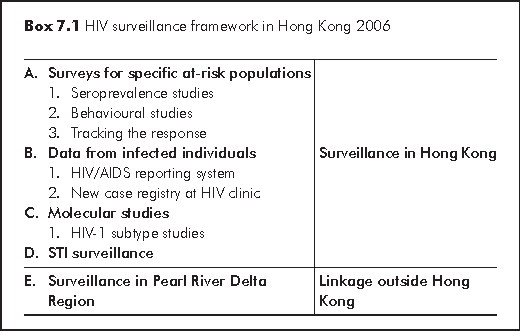
This chapter provides an overview of HIV surveillance system with a focus on its adaptation in Hong Kong, a low level epidemic state. We divide surveillance activities under two broad categories in accordance with the populations targeted: those targeting specific at-risk populations, and data from infected individuals. Box 7.1 shows the framework of the HIV surveillance system in Hong Kong.
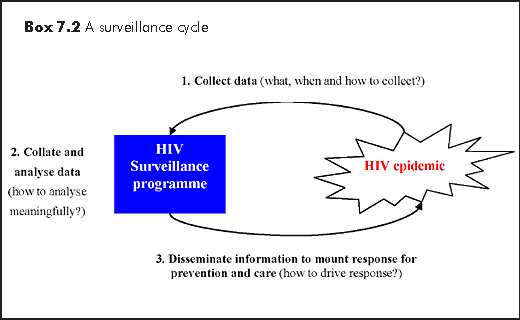
Surveillance is defined as 'ongoing systematic collection, analysis and interpretation of outcome specific data for use in the planning, implementation, and evaluation of public health practice, closely integrated with the timely dissemination of these data to those who need to know'.2 In a nutshell, surveillance is a regular and continuous process involving three key steps as depicted in Box 7.2. Surveillance programmes have been established for wide ranging specific purposes; the two most important ones are described below.
The most important function of an HIV surveillance system is to inform programme decisions. Through describing the epidemiological profile of HIV infections, appropriate actions can be worked out to meet prevention and care needs. HIV epidemic is notorious for its capability to spread rapidly and unnoticed in high-risk communities. The cost of a single infection can be tremendous when compared to prevention. In low-level epidemics, due attention is warranted for early warning signals of risk of spread so that preventive measures can be implemented as early as possible. Along the same line, surveillance data are also the key material for advocacy to mount effective response.
On the other hand, surveillance data are increasingly being used to evaluate national prevention and care programmes. There have been controversies on the attribution of changes in HIV prevalence to programme effects. Attention should in fact be drawn to the identification of appropriate indicators and appropriate analysis using available surveillance data. A case in point is the scenario of rising HIV prevalence after launching of a testing and safer sex promotion project. While the actual incidence may in fact be on the downward trend, this may not be reflected in the number of case reports and prevalence data, because of the increase in proportion of population tested.
To meet the specific objectives of surveillance, key questions that need to be asked are: where is the infection occurring? Where is there the risk for spread? Regardless of the source of infection or method for collection, a necessary starting point thus naturally falls on defining the population under surveillance. This could be difficult for populations at high risk for HIV as they are usually marginalised in the society, which underscores the importance of formative studies to have these established. The community level sources of data are determined by assessing the followings:
(a) In which sub-populations are the high risk behaviours concentrated?
(b) What is the size of those sub-populations? (size estimation)
(c) How much HIV is there in these sub-populations? (seroprevalence studies)
(d) What behaviours expose people in these sub-populations and how common are they? (behavioural studies)
(e) What are the links between sub-populations and the general populations? (behavioural studies, qualitative studies)
Gauging the size and describing characteristics of these populations are useful to determine the representativeness of the sample included in surveillance, to estimate the overall prevalence of HIV, and to assess the scale of necessary interventions to reduce the spread and impact of HIV. Methods have been proposed for estimating size of these populations.3
It is now well known that in most Asian countries, the main sub-populations at risk of HIV infection are the clients of sex workers, sex workers, men having sex with men (MSM) and injection drug users (IDU). At different points of the epidemic, there could be other sub-populations that become important for surveillance. For example, wives or regular sexual partners of clients of female sex workers in Thailand are now accounting for a substantial proportion of the infections in the country, after very high level of infections in the female sex workers and their clients starting in early 90s. Nonetheless, other sub-populations are almost invariably related to main sub-populations mentioned above.
The core components in HIV surveillance in low-prevalence areas are seroprevalence studies and behavioural studies. Methods to collect data for surveillance are usually determined by their practicality, uniformity and rapidity rather than accuracy or completeness.4 Very often, data from multiple sources are integrated for triangulation to arrive at a reasonable assessment of the overall situation for a particular sub-population.
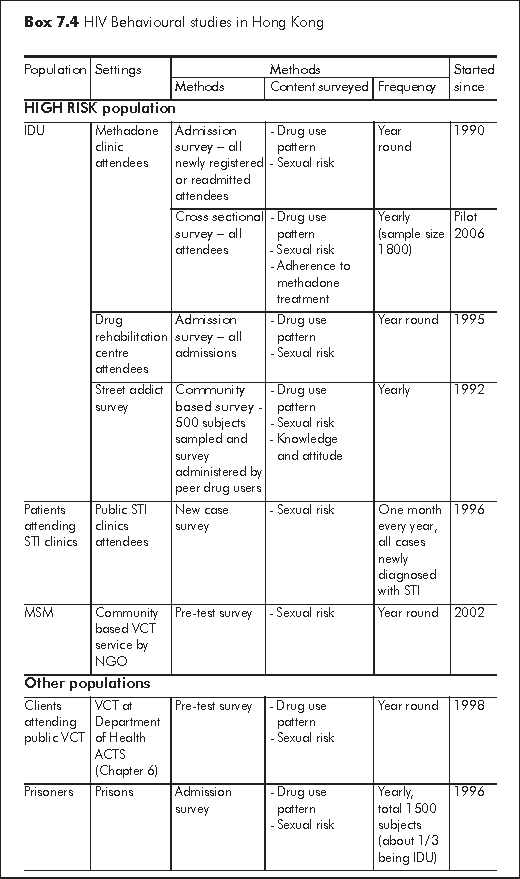
Settings where these studies take place therefore are preferably established venues where the specific populations gather for various purposes. For example, the network of methadone clinics provides a very convenient access points for HIV surveillance of IDU. The clinics are attended by about 7000 drug users everyday, against the background of some 10000 who are registered. Similarly, in drug treatment centres and prisons where large number of IDU are accessed, the venues serve as "sentinels" for surveillance. Currently both seroprevalence and behavioural studies are conducted at these sites in Hong Kong (see Boxes 7.3 and 7.4). Caution must however be exercised in generalising the results in assessing the situations in the populations, as there may be biases towards the higher or lower risk sub-populations within IDU.
Other settings include STI clinics (Social Hygiene Clinics) where counselling and testing services are offered to people practising high risk sexual behaviours. Again, understanding the profiles of attendees and limitations at specific sites are essential to appreciate the meaning of data collected. The public STI clinics in Hong Kong are used as convenient sentinels for clients of sex workers. It has the advantage of a high caseload but bears the limitation of a blurred demarcation between female sex workers and partners of clients. In these clinics, HIV test is universally offered to all cases and thus serves as a measure for seroprevalence. Otherwise, female sex workers and MSM are contacted largely through outreach programmes by community based organisations. Small scale community based prevalence and behavioural surveys have been undertaken in the past.5 Similar but systematised surveys are being planned and piloted by the Centre for Health Protection.
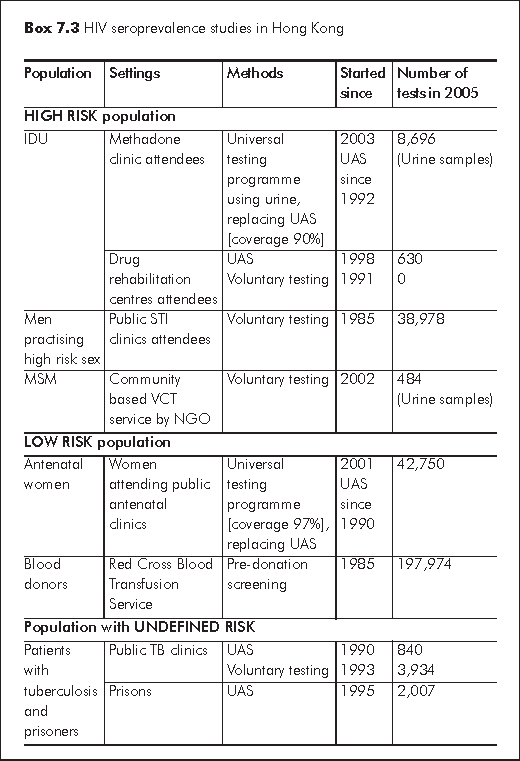
Seroprevalence studies can either take the form of unlinked anonymous screening (UAS), other forms of linked anonymous testing, voluntary testing, and screening of donated blood. Locally in settings like prisons and methadone clinics, urine specimens are collected for testing. UAS (refer to Chapter 6) has been the cornerstone for assessing seroprevalence because it minimises selection bias in case of voluntary testing, and can be conveniently conducted in settings where specimens are routinely collected for other purposes, like routine testing for neonates. Research has demonstrated that a testing programme with coverage higher than 95% could achieve the same purpose as UAS.6 In the case of antenatal testing, the high uptake rate of 97% in voluntary testing has led to the replacement of the former UAS locally. Similarly in methadone clinics, universal testing programme was introduced in 2004 and replaced the UAS as the surveillance method.
There has been a growing interest in behavioural surveillance for HIV risk in low-level and concentrated epidemic areas in last decade or so. The rationale is that HIV incidence basically is a function of the chance of being infected in a specified act with a partner who is HIV positive (say 0.67% for sharing injecting equipment), chance of partner being HIV infected (that depends on prevalence of HIV among injecting drug users, say 0.3% locally) and the frequency of the act (e.g. sharing injecting equipment among injecting drug users, say 20% locally). Even before infections occur, behaviour trend provides early warning signals in low prevalence countries and calls for timely response. Monitoring both prevalence and behaviour can therefore provide a much greater confidence in assessing the risk for HIV spread. Behavioural surveys are developed based on core questions of unprotected intercourse between FSW and their clients, unprotected anal intercourse between MSM, and sharing of needles in IDUs.7 However there are inherent difficulties in collecting reliable and valid behavioural data on sex and injection drug use. Keeping such questionnaire simple while obtaining all required information is a huge challenge.
STI and HIV share the same route of transmission. The risk of HIV transmission is increased in the presence of STI, while the presence of STI in HIV infection signifies the practice of risk behaviours. Surveillance of STI is considered as a component of a comprehensive HIV surveillance programme. In Hong Kong, STI surveillance is a separate system coordinated in conjunction with the Social Hygiene Clinics, and is made up of the caseload statistics of the clinics.
Notification of HIV/AIDS could be a statutory requirement and name based in some countries, (for example, United States), or voluntary, and anonymous as in the case of Hong Kong. In the latter case, HIV/AIDS reporting has been in place since 1984. This is a dual mechanism involving the reporting of newly diagnosed HIV and AIDS cases by attending physicians using standardised reporting form (DH2293) and by laboratories providing confirmatory tests in the public service (Public Health Laboratory Centre, Queen Elizabeth Hospital and Prince of Wales Hospital). Apart from demographic data, specific data collected include the speculated transmission route, diagnosis of AIDS-defining illness (in accordance with the criteria adopted by Scientific Committee of AIDS of the Hong Kong Advisory Council on AIDS in 1995). Case reporting is useful to track route of infection, testing pattern, source of diagnosis and timeliness of the diagnosis.
While reporting from laboratories may be relatively complete, effective cooperation from physicians is required for case reporting. Among the 1466 HIV case reports received between 2000 and 2005 in Hong Kong, 80% had both physicians and laboratory reports received, while the rest were reported by the laboratories only. This has resulted in incomplete case reports with unknown risk factors or demographic data. Nonetheless, this again reminds us of the importance of taking an integrated approach in interpreting the data collected from different sources. For practical reasons, it's understandable that systems built for surveillance purpose can never be perfect.
In Hong Kong, a case registry has been set up since 2000 in the HIV specialist clinic managed by the Department of Health, which can contribute epidemiologic data to supplement the reporting system. With the consent of patients and operating in anonymity, data collected include demographics, HIV risk factor, approximate timing of infection, setting leading to HIV diagnosis, impact of the infection and access to care.
There has been growing interest to track incidence of HIV infection to provide accurate, timely, and more robust measure of recent HIV transmission. Various laboratory methods have been proposed: detection HIV-1 antigen (p24), use of ultra-sensitive nuclei acid amplifications assays and the STARHS (serological testing algorithm for recent HIV seroconversion) algorithm, which is being used in USA.8 The branched peptide antigen (BED) assay that measures the concentration of HIV-specific antibody present in the leftover diagnostic serum has not been recommended for routine surveillance by UNAIDS in 2006.9 At the Department of Health's HIV clinic in Hong Kong, a mechanism is in place to document the previous negative test and seroconversion illness, as has been introduced in Australia.10 With data captured in the case registry, a patient is classified as having a recent HIV infection if he or she had a last negative HIV antibody test within 12 months prior to the first positive antibody result, and/or seroconversion illness within 12 months prior to the first positive HIV antibody test. Anonymous data from the clinic are regularly fedback to and analysed at the surveillance unit. Results of the first five years of operation have been published.11 In the same clinic, a system to collect regularly clinical governance markers has been pursued. The markers include clinic caseload statistics, risk management indices and clinical effectiveness indicators including CD4/viral load testing, viral suppression, drug adherence, new AIDS events, default follow up and death.
Transmission of multi-drug resistance strains (MDR, resistance to 2 or more classes of antiretroviral drugs) is of major public health concern. The World Health Organization has recommended countries introducing antiretroviral therapy to also implement an HIV drug resistance surveillance system.12,13 Such practice can inform the modification of treatment regimens, and is particularly relevant if standard guidelines is used across a country. In Hong Kong, less than 1% of the newly diagnosed patients is infected with MDR strain.
Tracking of HIV-1 subtype has been promulgated by researchers and experts as early as 1996,14 and lately in 2005.15 The public health rationales include: undertake prompt epidemiological investigation of transmission patterns and unusual strains, increase understanding of local HIV epidemics, support vaccine development and other preventive measures and treatment regime, and enhance development and use of appropriate laboratory tests for HIV screening, diagnosis and patient monitoring. Hong Kong has started to track HIV-1 subtype distribution since 2000 as a pilot project. HIV-1 subtyping is performed at the Public Health Laboratory Centre using standard laboratory methods followed by phylogenetic analysis to examine sequence variation and relationship.
As of 2005, a total of 1111 case reports captured in the voluntary HIV reporting have the subtype characterised. Valuable information and knowledge has been gained, including identification of new strains previously undiagnosed in the territory, and the detection of a cluster of at least 20 infections in 2005, the latter indicating for the first time more rapid and indigenous spread of HIV infection locally between MSM. It adds sensitivity to the overall surveillance system by providing clear early warning signals of rapid local spread, which is of particular importance to low-level epidemic area, and for the vulnerable yet hard-to-reach population such as MSM in Hong Kong. This unique piece of information obtained has been extremely useful to enhance the sensitivity of the HIV surveillance system in Hong Kong.
HIV spreads across national boundaries and human mobility is always an associated factor. Hong Kong is geographically part of Pearl River Delta (PRD) region in Southern China. With the high volume of human traffic across the border, measures to enhance tracking of HIV situation in PRD are of same importance as tracking those locally. A working group on HIV epidemiology in the Pearl River Delta Region was set up in 2003 involving HIV epidemiologists from 13 cities in PRD to develop framework for collaboration, enhance technical exchange on HIV epidemiology in the region through regular communication and meetings. Currently, an electronic platform has been built to share and disseminate HIV surveillance data in member cities. Data currently captured include yearly number of reported HIV and AIDS cases and seroprevalence in high risk populations.
Surveillance data as described in this chapter are not meant to be used in isolation. Normally, other ad hoc studies are collated and critically analysed together to generate meaningful information. Due to the long asymptomatic nature of HIV infection, it is difficult to appreciate its temporal and spatial distribution in a population. Over the years, various mathematical tools have been developed to support the analysis of the size and dynamics of HIV epidemics in different localities through integrative analysis of epidemiologic, behavioural and programme data.16 Some of these are simple enough for use by local health department to guide response. In Hong Kong, three exercises for estimating the size of the epidemic were conducted in 1994, 1997 by Dr James Chin using back calculation and in 2006 by Dr Tim Brown using Asian Epidemic Model. Readers may wish to refer to their reports for details (www.aids.gov.hk).
In Hong Kong, information generated from surveillance system is disseminated through quarterly press meetings, quarterly statistics reports, and yearly surveillance reports summarising the essential information. There are also ad hoc publications in the form of thematic reports (such as on UAS) and factsheets (on cluster of infections). Meetings or seminars with community workers or public are held as necessary (such as on rising infection in MSM to community groups) to ensure that essential information is disseminated to those who need to take preventive measures while minimising potential stigmatisation from unwarranted influence through general media. Surveillance data and reports are available electronically through the internet (www.aids.gov.hk).
As the epidemic evolves, huge amount of data are continuously generated. The focus has now been shifted to establishing functional capacity for meaningful analysis of the data, so that timely translation can be made to inform appropriate public health actions, for the dual goals of preventing HIV effectively and providing care for the infected. To this end, efforts must be made to build technical skills for data analysis, information dissemination and advocacy to institute changes.
Attributes for effective surveillance programme include simplicity, flexibility, sensitivity, timeliness and data quality (Box 7.5). While the HIV surveillance system in Hong Kong has not gone through vigorous evaluation, a number of observations can however be summarised to describe its characteristics.
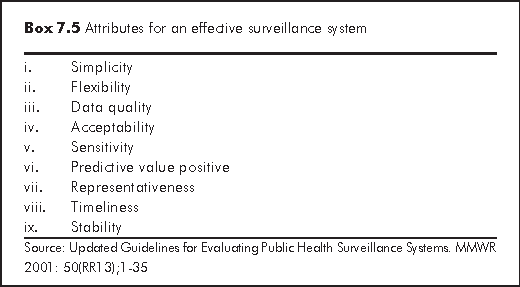
Firstly, there is no doubt that the current system is not yet perfect. There are important gaps to be filled such as surveillance in hard-to-reach populations like female sex workers and MSMs. Against the backdrop of a changing HIV landscape, a number of new pilot projects are currently underway. As in the past, the system is flexible enough to incorporate timely and appropriate studies (such as UAS for elderly population in 2004) or investigation of cluster of HIV infections. Social network analysis and spatial epidemiology are other areas that need to be strengthened.
Secondly, surveillance activities in Hong Kong have so far been following up-to-date international guidelines. In particular, respect for confidentiality and voluntary nature of sampling for surveillance are strictly followed. The Scientific Committee on AIDS and STI also provides locally relevance guidance on various issues.
Finally, partnership between the surveillance programmes, laboratory support, community and governmental agencies is crucial. Integration with prevention and care activities is a unique feature that contributes to an effective public health response. Such strategy has facilitated the collection of sensitive data from hard-to-reach marginalised groups in the community. Important information in turn can be effectively and timely communicated to those to who need to know and thus resulted in prompt actions.
Sources of data in this chapter have come from Special Preventive Programme, Department of Health, unless otherwise specified.
1. Special Preventive Programme, Centre for Health Protection. HIV surveillance report 2005 Update. Hong Kong: Department of Health. Available from www.aids.gov.hk.
2. World Health Organization and Joint United Nations Progrmame on HIV/AIDS. Second generation surveillance for HIV: The next decade. Geneva: UNAIDS/WHO, 2000. Available from data.unaids.org/Publications/IRC-pub01/JC370-2ndGeneration_en.PDF.
3. Theresa Diaz and Anne Buv? editors. HIV surveillance in resource-constrained settings. AIDS 2005;19 (suppl 2):S1-72.
World Health Organization and Joint United Nations Programme on HIV/AIDS. Second generation surveillance for HIV: The next decade. Geneva: WHO/UNAIDS, 2000.
Centers for Disease Control. Comprehensive Plan for Epidemiologic Surveillance. Atlanta: CDC, 1996.
UNAIDS working group on HIV/AIDS/STI surveillance. Estimating size of populations at risk for HIV - issues and methods. Geneva: UNAIDS, 2003.
Eylenbosch WJ, Noah ND (eds). Surveillance in Health and Disease. Oxford: Oxford University Press, 1988.
Lau JTF. Estimating prevalence of HIV and Chlamydia trachomatis among FSW and male clients of FSW. Report submitted to Hong Kong Council for the AIDS Trust Fund, 2004.
Hladik W, Masupu K, Roels T, et al. Prevention of mother-to-child transmission and voluntary counseling and testing programme data: what is their utility for HIV surveillance? AIDS 2005;19 Suppl 2:S19-24.
Garnett GP, Garcia-Calleja JM, Rehle T, Gregson S. Behavioural data as an adjunct to HIV surveillance data. Sex Transm Infect 2006;82 Suppl 1:i57-62.
McDougal JS, Pilcher CD, Parekh BS, et al. Surveillance for HIV-1 incidence using tests for recent infection in resource-constrained countries. AIDS 2005;19 Suppl 2:S25-30.
UNAIDS reference group on estimates, modelling and projections. Available from http://www.unaids.org/en/HIV_data/Epidemiology/default.asp (accessed 16 August 2006).
McDonald AM, Gertig DM, Crofts N, Kaldor JM. A national surveillance system for newly acquired HIV infection in Australia. National HIV Surveillance Committee. Am J Public Health 1994;84:1923-8.
Special Preventive Programme, Centre for Health Protection. Tracking the characteristics and outcome of HIV/AIDS patients cared for at the Integrated Treatment Centre - a report of 1999 to 2005. Hong Kong: Department of Health, 2006. Available from www.aids.gov.hk
World Health Organization. Scaling up antiretroviral therapy in resources limited settings. Guidelines for a public health approach. Geneva: WHO, 2002.
Lazzari S, de Felici A, Sobel H, Bertagnolio S. HIV drug resistance surveillance: summary of an April 2003 WHO consultation. AIDS 2004;18 Suppl 3:S49-53.
Hu DJ, Dondero TJ, Rayfield MA, et al. The emerging genetic diversity of HIV. The importance of global surveillance for diagnostics, research, and prevention. JAMA 1996;275:210-6.
Bennett D. HIV [corrected] genetic diversity surveillance in the United States. J Infect Dis 2005;192:4-9.
Ghys PD, Walker N, Garnett GP. Improving analysis of the size and dynamics of AIDS epidemics. Sex Transm Inf 2006;82 (suppl 2):iii1-2.