CF Ho, SS LEE
There are difficulties in sustaining the practice of protective behaviour, and this refers also to people living with HIV. In a review of 22 studies on the continuation of risk practices among known positive persons in Northern America, Europe or Australia, about one third kept on practising risky sexual behaviours after their diagnosis.1 In Hong Kong, new sexually transmitted infections had been diagnosed in HIV positive persons,2 and a cluster of 20 HIV infections were detected among men who having sex with men in 2005.3 With the introduction of combination antiretroviral therapy, some people may have perceived less HIV/AIDS threat and relapsed into risky sex.4 As every new HIV transmission involves an HIV-infected person who has infected another person, targeting prevention at HIV positive persons is advocated by both the Joint United Nations Programme on HIV/AIDS (UNAIDS) and the Centers for Disease Control and Prevention of United States (US CDC). However, an internationally agreed protocol of prevention programmes targeting HIV positives is not yet available.
To achieve an effective control of HIV transmission from an infected person to others, the principles are: (a) encouraging the uptake of HIV test of at risk persons and (b) preventing new transmission by working with HIV positive persons.5 Clinical HIV care offers a platform to work with HIV positive persons to prevent new infections. In Hong Kong, HIV specialist care is delivered almost exclusively via two specialist services: the AIDS Clinical Service of Queen Elizabeth Hospital and the Integrated Treatment Centre of Department of Health.6 Nurses take up the core role as case manager to oversee drug adherence, provide health counselling, deliver interventions and coordinate services for HIV affected individuals.6 An integrated team can consolidate this role, and can be expanded to include public health prevention. The model described in this chapter is taken from the approach at the Integrated Treatment Centre.
Prevention of HIV spread is a public health activity, and a systematic approach is needed in having a programme in place. The objectives of a programme that targets HIV infected individuals in prevention are three-folds:
(a) To minimise the risk of spread of HIV infection from known positive patients.
(b) To protect partners and carers from HIV infection.
(c) To support the development of strategy and programmes on the effective control of the epidemic in Hong Kong.
The hallmark of a programme is a profile of tasks centering on the HIV positive persons. An information system is crucial to record the incidents, track the process, and evaluate the outcomes. The specific components of such programme are:
(a) Case investigation.
(b) Risk reduction - the introduction of clinic-based risk reduction counselling on individual and/or group basis.
(c) Partner counselling and referral - this refers to the identification of partners, their testing, counselling and clinical referrals.
(d) Drug adherence counselling - with effective suppression of HIV replication, infectivity of persons on combination therapy (highly active antiretroviral therapy, or HAART) becomes lower,7,8 and good adherence is an important determining factor. Drug adherence counselling aims to promote adherence at a level of at least 95%, which is in fact achieved in Hong Kong.2 Discussion on adherence is detailed in Chapter 13.
(e) Post Exposure Prophylaxis (PEP) - post-exposure management in occupational settings. This is covered in Chapter 10.
Case investigation plays a central role in the surveillance and control of communicable diseases. The process enables public health professionals to determine the source of the infection, clustering, and factors associated with the infection. In so doing, informed intervention, often targeted, can be developed. In the case of HIV/AIDS, source determination is often not possible because of the latency of the infection and the complexity of behavioural factors involved. Conventional case investigation serves the purpose of evaluating the transmission routes of the infection and demographic characteristics, the results of which are transmitted through reporting to the concerned health authority.
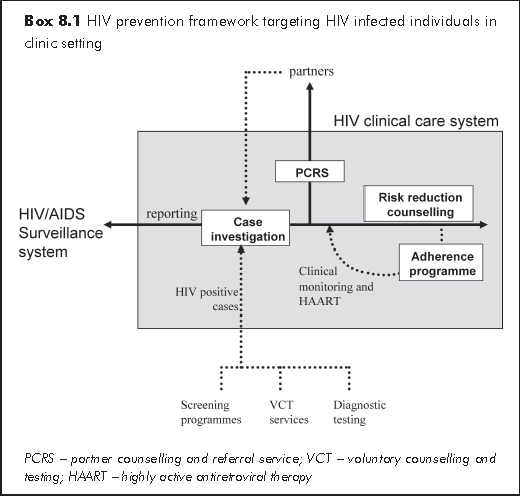
In targeting infected individuals for HIV prevention, case investigation takes on a more specific role of characterising the setting of the infection. There is then the linkage with other components of the service including risk reduction counselling, partner counselling and referral, and adherence programme (for those on HAART). Catchment of the service normally includes:
(a) HIV screening programmes - The following programmes are now in place in Hong Kong and have become an important sources of referral: universal HIV antibody (urine) testing in methadone clinics, universal HIV antenatal testing, screening of TB patients, screening of sexually transmitted infection (STI) patients at the Social Hygiene Service (refer to Chapter 6).
(b) VCT (voluntary counselling and testing) services - These are designated HIV testing sites for people who come forward to be tested because of behavioural risk or other concerns. This is normally community-based.
(c) Diagnostic testing at private or public health services, often as a result of a complication arising from HIV/AIDS.
The framework of HIV prevention programme centering on case investigation is illustrated in Box 8.1.
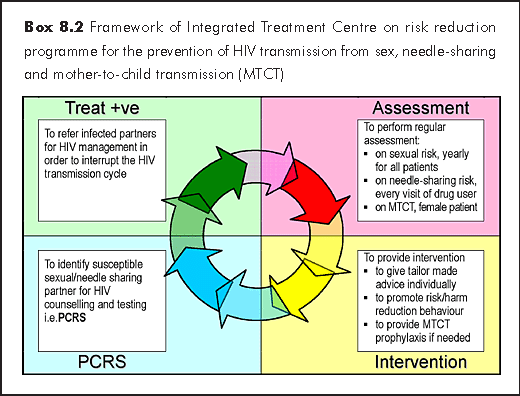
The main emphasis of risk reduction is the prevention of HIV transmission through: (a) sex, (b) sharing of needles and injecting equipments, and (c) mother-to-child infection, all involving the HIV positive index person. The introduction of risk reduction counselling as a service requires the following steps: (a) defining the clientele to be covered; (b) devising standardised risk assessment tool, which is normally divided into two components, viz, sexual risk assessment and needle-sharing risk assessment; (c) developing counselling and execution protocols. Box 8.2 illustrates the series of activities and the role of PCRS in the risk reduction counselling.
It is important to promote the reduction of risk behaviours and the maintenance of safer practices. US CDC recommends a series of activities targeting the HIV positives which have provided hints on how the work can be done. This series of activities are to: (a) perform brief screening for the risk of HIV transmission, (b) communicate prevention messages, (c) discuss sexual and drug-use behaviour, (d) provide positive reinforcement to safer behaviour, (e) facilitate partner notification, counselling and testing, and (f) identify and treat other sexually transmitted diseases.9 They serve as a good reference for the evaluation and expansion of the clinic-based work in public health of ITC.
Partner Counselling and Referral is organised as a service (Partner Counselling and Referral Service, or PCRS) to explore the linkage of the index person with other related partners in his/her social network. The aim of such service is to lead to an interruption of the chain of HIV transmission and early identification of the infected for referral for treatment. In a systematic review on the effectiveness of partner notification for STI/HIV involving 91 related reports including 38 reports on HIV, it was discovered that the yield for HIV partner notification was about half of STI, i.e. one new case found for every 8 or 10 interviews of positive case. Despite the low yield, it was concluded that partner notification had an important role in HIV prevention and the information on partners and risk behaviours could provide epidemiologic insight in disease control.10
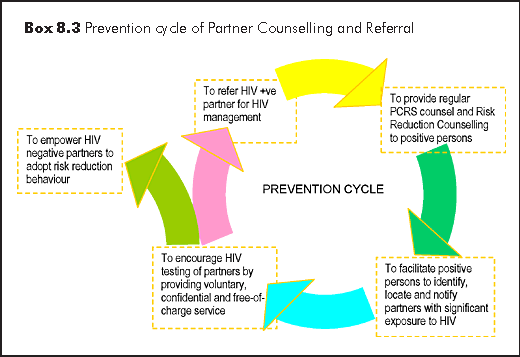
Since 2002, PCRS has been introduced in ITC (Box 8.3). It involves a series of disease prevention activities. By working with HIV-infected patients, PCRS identifies, locates, and notifies partners at risk of infection. Upon notification, these partners are offered HIV counselling, testing, and specialist referrals as appropriate. HIV counselling aims to empower partners, regardless of HIV status, with knowledge of HIV prevention. HIV testing enables HIV-infected partners, who may have hitherto been unaware of their status, to seek expeditious medical care. PCRS can be expanded to become an on-going programme for all HIV positive individuals. Four forms of referrals are used, each for a different setting:11
(a) Client referral - an HIV positive client him/herself informs his/her partners concerning possible exposure to HIV and advises him/her to receive voluntary HIV testing and counselling.
(b) Dual referral - the HIV positive client discloses his/her HIV status to partners in the presence of nurse counsellor, in a setting where immediate counselling and testing are available.
(c) Contract referral - nurse counsellor is given the partners' contact information, while the index client makes the initial attempt of notification. If the client is unable to complete the task within the agreed-upon time period, provider (see below) referral will be carried out.
(d) Provider referral - the index client volunteers contact information of his/her partners. The health care provider, without disclosing the identity of the index client, makes contact with and inform the at-risk persons of exposure to HIV infection, followed by the provision of counselling and voluntary testing.
While addressing individual needs, a systematic approach is crucial, which involves a standardised record form, execution guidance, and management protocol on handling of difficult patients.
It takes a multi-disciplinary team to support the prevention of HIV transmission from people known to be living with the infection. The involvement of HIV physicians and nurses is essential but inadequate. The participation of social workers and psychologists and/or psychiatrist would add value to the programme. Close collaboration with professionals of other health care services and community workers of non-government organizations is crucial. Human resources aside, the other challenges include the provision of information and training, and monitoring and evaluation.
To ensure smooth running of HIV prevention programme, the involvement of front-line workers throughout the programme development process is crucial. A careful balance has to be struck so as to maximise effort in disease control and also uphold quality of care. Regular meeting, formal and informal alike, could enable planners and front-line workers to integrate public health work into the daily practice. Training and briefing sessions are essential to develop understanding of the clinical team on: (a) the aim, objectives and scope of activities, (b) the definition of each item in the assessment, and (c) the basic elements expected in the behavioural interventions. Regular review meetings are held especially in the initial phase after implementation, supplemented by ad hoc meetings according to needs. Rolling out programme components in phases could allow adequate time for absorbing additional work into daily practices.
An information system plays a central role. The computerised Clinical Information System in ITC has been enhanced to support the new programme on prevention. Risk assessment and behavioural intervention generate results which are entered into the CIS. Counsellors are reminded of the next due day for risk assessment of each patient well in advance. The mechanism ensures that there is optimal coverage of the programmes, while timely information is provided to care providers to inform actions. Without interrupting clinic operation, relevant data are captured for input to the public health surveillance programme, and for generating regular reports.
Process monitoring and outcome evaluation should be incorporated in the programme. This involves the setting up of monitoring and evaluation markers for each component of the main programme. These markers are designed for answering the level of accomplishment to the established aims and objectives. With these markers, any variation in coverage and protective behaviour as well as increase in risk practice can be detected.
On a yearly basis, evaluation is conducted to assess the behavioural patterns of patients and the coverage of each component. At the ITC these results are distributed to health care workers of the clinic during the regular service meetings. Considering the potential risk of spread and the public health consequences, some components of the programme are reviewed much more frequently. For example, the increase in the number of new drug users is evaluated monthly while the overall drug adherence grade to antiretroviral therapy of treated patients is examined quarterly. Should significant change be identified, the responsible subject officers of the AIDS programme is alerted. Further investigation could be conducted to explore the observed swing and timely response could be introduced.
Kalichman SC. HIV transmission risk behaviors of men and women living with HIV-AIDS: prevalence, predictors, and emerging clinical interventions. Clinical Psychology: Science and Practice 2000;7:32-47.
Special Preventive Programme. A clinical governance report on the monitoring and evaluation of HIV clinical management at Integrated Treatment Centre 1999- 2004. Hong Kong: Centre for Health Protection, Department of Health, 2005.
Surveillance Office of Special Preventive Programme. Fact Sheet (2) on a cluster of HIV infections in Hong Kong. Hong Kong: Centre for Health Protection, Department of Health, 2006. Available from www.info.gov.hk/aids/pdf/g153.pdf (accessed 22 May 2006).
Stolte IG, Dukers NH, Geskus RB, et al. Homosexual men change to risky sex when perceiving less threat of HIV/AIDS since availability of highly active antiretroviral therapy: a longitudinal study. AIDS 2004;18:303-9.
Janssen RS, Holtgrave DR, Valdiserri RO, et al. The Serostatus Approach to Fighting the HIV Epidemic: prevention strategies for infected individuals. Am J Public Health 2001;91:1019-24.
Scientific Committee on AIDS (SCA). Recommended framework for the delivery of HIV clinical care in Hong Kong. Hong Kong: Centre for Health Protection, Department of Health, 2005.
Porco TC, Martin JN, Page-Shafer KA, et al. Decline in HIV infectivity following the introduction of highly active antiretroviral therapy. AIDS 2004;18:81-8.
Castilla J, Del Romero J, Hernando V, et al. Effectiveness of highly active antiretroviral therapy in reducing heterosexual transmission of HIV. J Acquir Immune Defic Syndr 2005;40:96-101.
Centers for Disease Control and Prevention (CDC); Health Resources and Services Administration; National Institutes of Health; HIV Medicine Association of the Infectious Diseases Society of America. Incorporating HIV prevention into the medical care of persons living with HIV. Recommendations of CDC, the Health Resources and Services Administration, the National Institutes of Health, and the HIV Medicine Association of the Infectious Diseases Society of America. MMWR Recomm Rep 2003;52(RR-12):1-24.
Brewer DD. Case-finding effectiveness of partner notification and cluster investigation for sexually transmitted diseases/HIV. Sex Transm Dis 2005;32:78-83.
Centers for Disease Control and Prevention (CDC). HIV partner counseling and referral services guidance. USA: CDC, 1998.