SS LEE
HIV infected individuals suffer from the chronic complications of immunodeficiency. The prevention and treatment of these complications, coupled with the use of highly active antiretroviral therapy (HAART), lay the foundation of what is now referred as "HIV medicine". The practice of HIV medicine has, however, undergone changes over the years, and it varies from one place to another. Clearly, the clinical symptomatology of HIV/AIDS touches almost all possible medical disciplines. While HIV/AIDS could ideally be 'practised' by all medical practitioners, this has not happened because of the growing complexity of the subject, intensive research underlining new treatment strategy, and the dynamism of the disease unmatched by other clinical conditions. HIV/AIDS poses yet another challenge by exposing the medical profession to areas which some may not feel at ease with - risk behaviours, sexuality, marginalised communities, and the ever-ending ethical debates on the prevention and control of the infections.
This chapter deals with the system for providing clinical HIV management. While the general principles of good clinical practice apply equally to HIV medicine, characteristic features have emerged because of the specific needs of the local community, the uniqueness of Hong Kong's health care system, and the historical path of expertise development. A model of clinical care has therefore emerged in response to the needs of patients in Hong Kong.
The historical path of discoveries in HIV/AIDS reflects on how HIV medicine has evolved over the years. AIDS was perceived as a clinical syndrome in 1981. The isolation of HIV, its causative agent, was not made until 1982/1983, followed by the availability of diagnostic tests in 1985. In the early to mid-eighties, monitoring with CD4 enumeration and the diagnosis and treatment of opportunistic infections were the mainstay of HIV medicine. AIDS specialists in those days were either respiratory physicians (who managed Pneumocystis carinii pneumonia, PCP), other medical specialists, experts in intensive care or clinical infectious diseases. AIDS was the focus of HIV medicine, which was, naturally, part and parcel of acute medicine. Counselling played an important role in helping the young AIDS patients who were suffering from the stigmatising fatal disease. The effectiveness of prophylaxis against opportunistic infection like PCP alerted the medical profession that HIV/AIDS could be managed as a chronic illness. This belief was reinforced in the late eighties by the short-term efficacy demonstrated by antiretroviral monotherapy. Hospice care flourished, in response to the needs of young AIDS patients who were going through a painful debilitating disease, with bouts of deterioration in its progressively downhill course to inevitable death. Concurrently, primary care had emerged as a model for managing HIV/AIDS during the early stages of the infection, when intensive counselling, health maintenance, CD4 monitoring and PCP prophylaxis (with or without antiretroviral monotherapy) were the pillars of HIV medicine. Community-based models were set up to bring HIV/AIDS patients closer to their homes and neighbourhood.
Between late-eighties and mid-nineties, there was a gradual shift from hospital-based to out-patient based services for HIV/AIDS patients.1 Other non-hospital services like home care and residential facilities were set up, which all carried a very strong identity of being linked with the community.2,3 Hospital admissions had decreased even before combination antiretroviral treatment became available in developed countries.4 There was also movement towards the setting-up of comprehensive designated HIV clinical services, especially in places where HIV/AIDS patients concentrate.5
Since the mid-nineties, the advent of HAART and the application of viral load testing have brought new challenges to HIV clinical services providers. While patients are living longer, the complexity of HIV treatment has grown further. HIV medicine encompasses an ever-expanding spectrum - the prescription of HAART, adherence programmes, the use of salvage therapy, management of treatment complications including metabolic side effects, and the rapid incorporation of new investigations in clinical services - genotypic and phenotypic resistance testing, and therapeutic drug monitoring.
There is no single model on clinical HIV management which can be universally applied in countries around the world. The historical development described above does highlight the key objectives of a clinical HIV management system - providing for the prevention and treatment of opportunistic complications, monitoring HIV disease, and optimising HAART for patients. Knowingly, the ultimate goal of an effective clinical HIV management system is to enable one to lead a normal life. In this connection, the following principles are essential:
(a) access to the clinical care;
(b) continuity of care;
(c) effective mobilisation of community resources;
(d) adaptation of professional expertise; and
(e) integration with the local health care infrastructure.
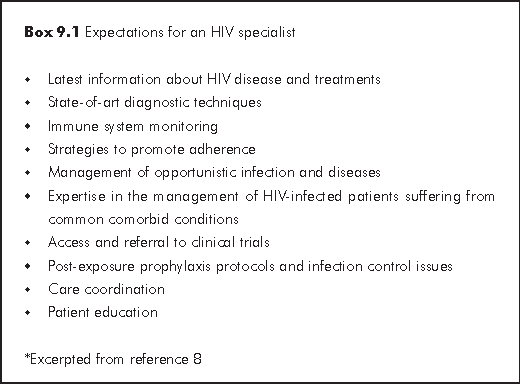
In the past there were debates on whether HIV/AIDS constitute a "primary care disease".6 With the widespread use of HAART, especially in developed nations, this concept became less popular. A study revealed that AIDS patients under care of experienced doctors had a better outcome.7 Such observations testify to the notion that specialist care is desirable in managing HIV infection. Box 9.1 gives a good summary of the expectations for an HIV specialist, adapted from the clinical guidelines of New York State Department of Health.8 It must be noted, however, that HIV specialists can be ID (clinical infectious diseases) physicians, clinical immunologists, other clinical specialists or primary care physicians. The definition of a specialist is therefore gauged by the breadth of knowledge, skills and experience in HIV treatment, rather than the qualifications or discipline.
On the other hand, conventional primary care doctors and other medical practitioners not specialising in HIV treatment do have their roles in HIV prevention and care in their practice. This includes the diagnosis of HIV/AIDS, promotion of risk reduction for preventing HIV infection, and the management of conditions suited to each specialty. The prevention of mother-to-child infection by an obstetrician is an example of the latter. Non-HIV medicine doctors may also facilitate the coordination of services for infected clients, and support their family in the long-term care of the disease. With the increasing life expectancy of HIV patients on HAART, non-HIV specific conditions are emerging as important health concerns. They are now collectively referred as HIV primary care in some countries.9
There were efforts to better define the core competency of HIV specialists. Organisations have been established to promote the setting of standards in HIV medicine, for example, American Academy of HIV Medicine, HIV Medicine Association, International AIDS Society. Experience, commitment and currency of knowledgebase (in keeping updated on the fast-moving field) are the major components to HIV expertise. There is the tendency to disregard the original specialty of practising HIV specialist on one hand, and the move towards integration with such specialty as Clinical Infectious Disease to systematise training on the other.10
The development of clinical HIV programmes in Hong Kong follows closely that of developed countries. In the public sector, there are two HIV services that specialize in clinical management of adult HIV patients - the AIDS Clinical Service of the Hospital Authority's Queen Elizabeth Hospital, and the Integrated Treatment Centre (ITC), Department of Health. In mid-2006, it is estimated that altogether about 1500 adult cases are actively followed up at the two services. Other institutions take part in HIV care by taking on other unique roles. Some examples are: the Infectious Disease Division of Princess Margaret Hospital (in partnership with ITC), Department of Paediatrics of Queen Mary Hospital (caring for HIV infected children), and Prince of Wales Hospital (focusing on metabolic complications and clinical research).
The AIDS Clinical Service began as a hospital-based HIV service based at Queen Elizabeth Hospital. The ITC of Department of Health is an out-patient based programme operating from the Kowloon Bay Health Centre. The generic model of care is described in the following section.
Parallel with the development of clinical treatment models overseas, the Hong Kong model is characterised by:
(a) science-based protocol establishment;
(b) commitment to continuous professional development;
(c) community involvement in resource mobilisation and care delivery; and
(d) integration with clinical activities and professional development in the disciplines of infectious diseases, immunology, dermatology, STD treatment, infection control.
Three sets of activities are undertaken: firstly, medical intervention; secondly, health maintenance, and thirdly, self-help and community support. A team of medical doctors, nurses and social workers are responsible for the delivery of activities in this model. The components, inter-relationship and external linkages of the activities are illustrated in Box 9.2.
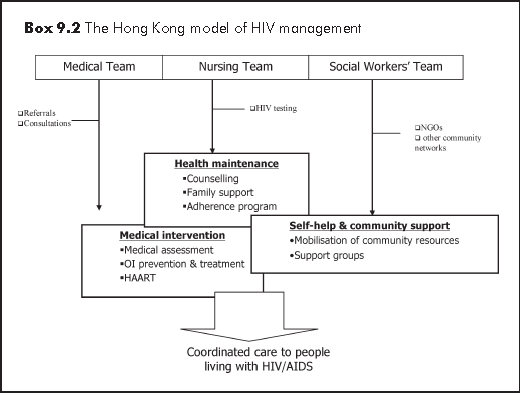
Medical intervention refers to the range of clinical activities designed to control symptoms and diseases arising from HIV infection, and to minimise their occurrence through the adoption of appropriate therapeutic measures targeting the virus or the immune system. These measures include (a) monitoring - immunologic, virologic and physical health assessment; (b) prevention and management of opportunistic infections and neoplasms, and (c) HAART. The activities are delivered by trained physicians with experience in HIV/AIDS management. Through consultations and referrals, there is exchange of expertise in HIV medicine and other medical specialties.
Health maintenance is a set of activities organised to promote health in HIV infected individuals and their families. Counselling is provided to patients and families by nurses specialised in HIV care. With the use of HAART, special programmes are conducted to promote adherence to the complex regimens. The nursing team works closely with psychologists and/or social workers in rendering support to patients and families. It's also inter-connected with HIV testing services.
Self-help and community support are activities coordinated by social workers for the purpose of helping each client lead a normal life. This is done through mobilisation of community resources and the conduction of support groups. Currently people living with HIV/AIDS are involved in the networking through organisation of activities and the publication of newsletters. Liaison with other non-governmental organizations is made to sustain the support network for people living with the infection.
In the delivery of health care, quality is both a vision and an attribute. The Institute of Medicine has defined quality as "the degree to which health services for individuals and populations increase the likelihood of desired health outcomes and are consistent with current professional knowledge".11 In pursuing the goal of quality in HIV medicine, clinical governance, defined as corporate accountability for clinical performance,12 provides a practical framework.
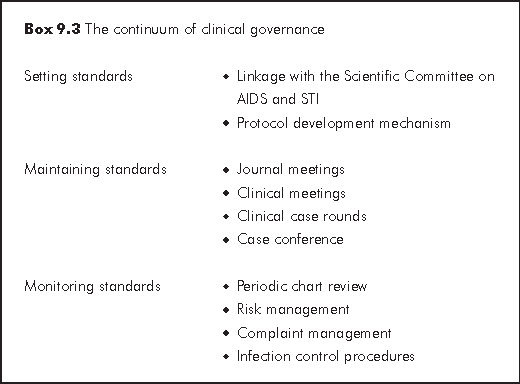
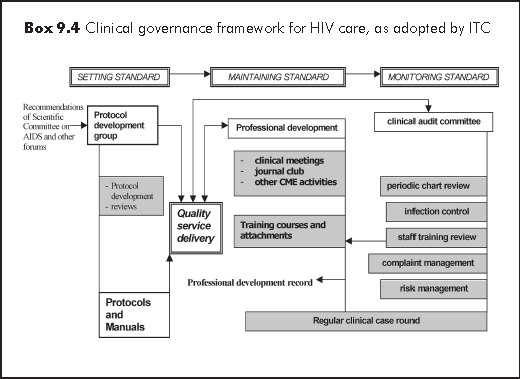
The framework of clinical governance can be considered as a continuum involving setting standards, delivering standards and monitoring standards (Box 9.3).13 This in fact forms the backbone of five spheres of activities described by ITC: (a) infection control, (b) evidence-based medicine, (c) risk and complaint management, (d) training and staff development, and (e) clinical audit. These activities and the framework are illustrated in Box 9.4.
While clinical medicine addresses the needs of individual patient, public health provides a broad perspective in linking the disease's impacts and response to the society. For HIV/AIDS, clinical HIV medicine is intricately associated with its public health dimensions. These dimensions cover prevention, surveillance and control of disease spread.
In clinic setting, prevention encompasses the provision of partner counselling and referrals, prevention counselling, STI (sexually transmitted infection) screening and treatment (Chapter 8). Therapeutic prevention is one means of reducing HIV transmission through the use of antiretrovirals. This is now a regular clinical activity in two specific settings: (a) antenatal care (Chapter 35), and (b) post-exposure prophylaxis in health professionals (Chapter 10).
Surveillance is a public health activity that consolidates the knowledgebase on the pattern of the disease in question. The conduct of effective HIV/AIDS surveillance requires the input of clinicians working on HIV medicine. Currently voluntary reporting is managed by the Special Preventive Programme Surveillance Office, which works closely with clinical HIV services in Hong Kong. This is a confidential system, the database of which does not contain personal identifiable information. The surveillance system is introduced in Chapter 7.
Conventional means of controlling infectious diseases requires the identification of the infected individuals, followed by measures to prevent secondary infections. Theoretically, this should apply to HIV/AIDS but is practically limited by (a) its association with high risk yet private nature of the behaviours, (b) the asymptomatic property of the infections, and (c) the unfeasibility of effective means of a chronic condition with long incubation period and low infectivity.
It is now generally agreed that an early diagnosis, appropriate antiretroviral treatment and risk-reduction counselling are effective means of minimising secondary infections. Control of HIV infection may be achieved if a large proportion of HIV infected individuals know their status. A new strategy has emerged that emphasises on increasing the number of infected individuals who are aware of their status, and the use of the clinical setting for prevention.14 An effective clinical service addressing the needs of an HIV infected person is, at the same time, a platform for controlling the infections.
Beck EJ, Kennelly J, McKevitt C, et al. Changing use of hospital services and costs at a London AIDS referral centre, 1983-1989. AIDS 1994;8:367-77.
Marazzi MC, Palombi L, Mancinelli S, et al. Care requirements of people with ARC/AIDS in Rome: non-hospital services. AIDS Care 1994;6:95-104.
Anderson S. Community responses to AIDS. World Health Forum 1994;15:35-8.
Fortgang IS, Moore RD. Hospital admissions of HIV-infected patients from 1988 to 1992 in Maryland. J Acquir Immune Defic Syndr Hum Retrovirol 1995;8:365-72.
Anonymous. Comprehensive HIV clinic creates new image for public AIDS Care. AIDS Alert 1994;January issue:6-8.
Metrikin AS, Zwarenstein M, Steinberg MH, Van Der Vyver E, Maartens G, Wood R. Is HIV/AIDS a primary-care disease? Appropriate levels of outpatient care for patients with HIV/AIDS. AIDS 1995;9:619-23.
Kitahata MM, Koepsell TD, Deyo RA, Maxwell CL, Dodge WT, Wagner EH. Physicians' experience with the acquired immunodeficiency syndrome as a factor in patients' survival. N Engl J Med 1996;334:701-6.
AIDS Institute, New York State Department of Health. Appendix I - HIV specialist policy. In: Criteria for the medical care of adults with HIV infection. New York: Department of Health, 2001. Avaiable at www.hivguidelines.org
AIDS Institute, New York State Department of Health. Primary Care Approach to the HIV-Infected Patient. New York: Department of Health, New York: Department of Health, 2004. Available from www.hivguidelines.org
Boswell SL, Hecht FM, Powderly WG, Soloway B, Volberding PA. HIV expertise: a roundtable. AIDS Clin Care 2001;13:79-81, 84-5.
Institute of Medicine. A statement of the Council of the Institute of Medicine: America's health in transition - protecting and improving the quality of health and health care. Washington DC: National Academy Press, 1993.
Gray GR. Clinical governance: the challenge. Royal College of Surgeons (Glasgow) Annual report, 1998.
Department of Health. A first class service - quality in the new NHS. UK: National Health Service, 1998.
Institute of Medicine. No time to lose - getting more from HIV prevention. Washington DC: National Academy Press, 2000.