Sik-To LAI
Travelling outside one's place of birth or residence may expose HIV infected persons to infections (occasionally opportunistic) not previously encountered. Social and other day-to-day activities during travel are potential channels of exposure to infectious agents, including foodborne, waterborne and vector-borne ones. Normally, the environment and facilities in developing countries contribute to a higher risk of these travel-related infectious hazards compared to developed countries. The endemic infectious pathogens at the destinations may cause more serious diseases in HIV positive travellers than healthy individuals, especially for those who are severely immunocompromised.1
Given the increased risk and complications arising from superimposed infections, it is natural that preventive measures should be taken appropriately.2 In this connection, recommendations are mostly derived from data in the pre-HAART era which shall still be applicable nowadays. Ways to minimise exposure to infections, e.g. food hygiene for food-borne diseases, avoidance of exposure to measles or chickenpox patients and protection from mosquito bites in yellow fever regions are important but may not be feasible for all situations. Acquiring immunity through vaccination or passive immunisation is a possible means for some specific diseases though the former response depends on immune status of the individual. Prophylactic anti-pathogen drugs, e.g. anti-malarial prophylaxis, is another useful measure. In general, HIV infected travellers who are not severely immunocompromised and are taking proper precautions and appropriate vaccinations should do well.
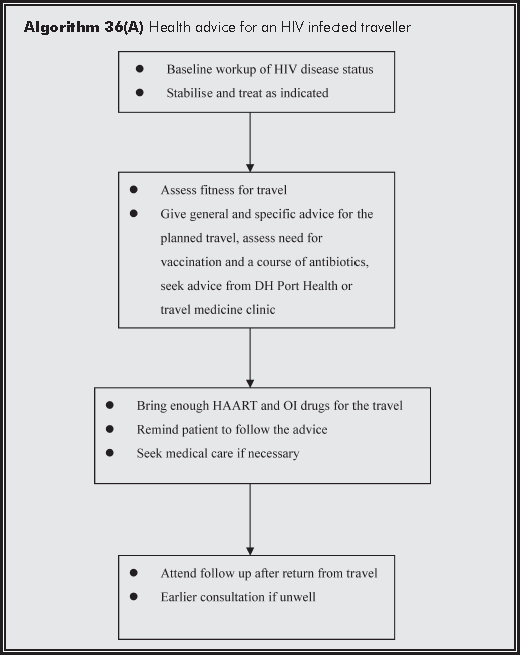
HIV/AIDS patients going for travel overseas should have the trip planned well ahead if possible. In general, HIV/AIDS patients are advised to refrain from going to places with endemic diseases that are not preventable or the prevention means is contraindicated in HIV/AIDS patients, e.g. yellow fever vaccine. They shall have assessment by the attending physician well before departure for necessary advice. The advice shall strike the balance between the risk of catching infection, availability and feasibility of prevention measures, and pros and cons of applying such measures in different settings.3 The Port Health Office of the Department of Health (or other travel medicine clinics) could be consulted for advice on vaccination and other precautionary measures for the place of travel, as in the case of HIV negative individual.
When going to a developing country, the traveller should review the itinerary for regions with possible malaria transmission. Mosquito bites may be prevented with 30-35% DEET (N, N-diethyl-meta-toluamide) insect repellent, bed netting, permethrin spray, covering the limbs by light coloured long-sleeved shirt and trousers, and avoidance of dusk to dawn exposure. Despite the observed drug interactions between chemoprophylactic agents for malaria and HAART drugs, no dose adjustments of either have been recommended. Malarone is the commonly preferred drug for chemoprophylaxis, though mefloquine is also frequently used. Malarone prophylaxis is given at 1 tablet per day with food 1-2 days prior to, during and 7 days after travel. Regarding treatment of malaria, the AUC of quinidine and, to a lesser extent, quinine is increased by ritonavir. Quinidine (or quinine) is usually contraindicated in patients taking ritonavir because of potential cumulative cardiotoxicty. Its concurrent use with amprenivir, delaviridine or the lopinavir/ritonavir combination should be closely monitored. Quinidine (or quinine), however, is still reserved for the treatment of severe malaria, mostly caused by Plasmodium falciparum, and the maintenance dose should be reduced with the concomitant use of ritonavir. Alternative drugs for the treatment of falciparum malaria include Malarone, artesunate and mefloquine. Self treatment is generally not advised.
Travellers' diarrhoea can be caused by a variety of organisms. Enterotoxigenic Escherichia coli (ETEC) probably have a similar presentation in HIV infected and normal persons. Salmonella, Campylobacter and Shigella can have worse clinical picture in HIV positive people. It is not a routine practice to recommend prophylactic antimicrobial agents against travellers' diarrhoea for HIV infected persons going to developing countries. However, these travellers should carry a supply of antimicrobial with them and start empirical treatment should diarrhoea develop. Ciprofloxacin 500 mg bd for 3 to 7 days with loperamide on the first day could be tried for mild cases. Medical consultation should be sought if the diarrhoea is severe (e.g. fever, bleeding, vomiting, dehydration, prostration) or not responding to self treatment.
Precautions against food and waterborne diseases in developing countries are the same for all travellers irrespective of the HIV status. Raw vegetables and peeled fruits, tap water, ice cubes, ice cream, cold drinks and snacks from street vendors should be avoided. Food and beverages that are generally safe include steaming-hot foods, fruits that are peeled by the traveller, bottled beverages, hot drinks, and water brought to a rolling boil for 1 minute. Portable water purifiers can be used. The traveller must pay attention to hand hygiene, including frequent and thorough hand washing. They should avoid direct soil and sand contact with skin (e.g. by wearing shoes, protective clothing, use of towel on beaches) in areas where faecal contamination of soil is likely. They should also avoid close contact with people having air-borne infectious diseases, e.g. tuberculosis, measles or chickenpox.
The attending physician may wish to review the dates of travel and the itinerary. The evaluation should be more aggressive than usual in an asymptomatic individual if his visit to developing areas was prolonged. For patients who have fever or other illnesses, the incubation period of the more common travellers' diseases should be checked:
(a) Short (less than one week): bacterial diarrhoea, cryptosporidiosis, haemorrhagic fevers
(b) Medium (up to one month): giardiasis, amoebic colitis, malaria, Salmonella typhi, leptospirosis
(c) Long: malaria, visceral leishmaniasis, viral hepatitis, amoebic liver abscess, schistosomiasis
While vaccination is useful for health maintenance of HIV infected people, its use can be limited by possible toxicity and lower efficacy in HIV/AIDS patients. Apart from active vaccination, passive immunisation can also render temporary protection to certain infections.4 Because of the reduced potency of vaccination, HIV infected travellers may have decreased protection from some or all of the vaccines administered. There may also be an increase of side effects to live vaccines in these individuals (especially with severe immunosuppression), e.g. death caused by measles vaccine. On the contrary, many HIV infected persons may develop complications from vaccine-preventable diseases due to their immune deficiency. One example is measles, which has a worse disease with increased morbidity and mortality with pneumonitis and encephalitis in HIV infected persons. The risk benefit balance is usually in favour of giving vaccines, especially inactivated, to these persons. Transient increases in HIV viral load, which return quickly to baseline, have been observed after administration of several different vaccines to HIV infected persons. The clinical significance of these increases is unknown but they do not preclude the use of any vaccine.
Vaccination in HIV/AIDS patients should therefore be considered against many factors,5 including (a) danger of live vaccines in causing diseases in the infected, (b) risk of spread to other people, especially immunocompromised ones, after live vaccines, (c) uncertainty of immune response and thus protection even after vaccination, especially for symptomatic or advanced immunosuppression patients, (d) risk of stimulating HIV replication, and (e) the applicability and indication of vaccines in different countries/places.
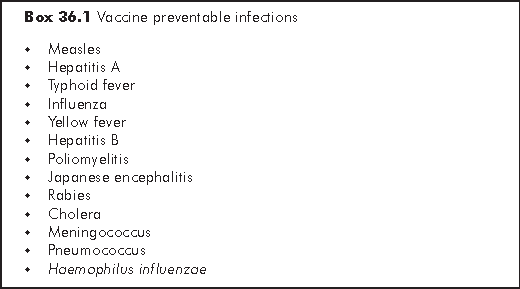
Vaccines are available to protect from a wide range of infections (Box 36.1) which an individual may be exposed to, and an HIV infected traveller is no exception.
The vaccines that may be used for these conditions include:
(a) Killed (inactivated): Haemophilus influenzae (Hib), hepatitis A, inactivated polio (IPV), rabies, Japanese encephalitis (JE)
(b) Live (attenuated): Measle/Mumps/Rubella (MMR), yellow fever
(c) Subunit: hepatitis B
(d) Polysaccharide: pneumococcus, meningococcus, typhoid Vi
(e) Split antigen: influenza
Generally speaking, inactivated and subunit vaccines are safe and can be used in HIV infected patients. Live vaccines are contraindicated due to the risk of severe adverse reactions. For this reason, inactivated killed polio vaccines are used instead of the oral live polio vaccine. However, exceptions occur when the benefit outweighs the risk. For example, the measles vaccine can be administered to paediatric patients in the early stage of the disease.
All asymptomatic HIV infected persons should be vaccinated with MMR if routinely indicated or in the setting of prolonged travel to areas endemic for measles. It should also be considered for symptomatic HIV infected persons who are not severely immunosuppressed. Routine vaccination has been part of the childhood immunisation programme in Hong Kong for over 30 years. The antibody level, however, should be checked since the response to measles vaccine can be variable. Re-vaccination is advised if the antibody response is inadequate. If hepatitis A immune globulin is prescribed besides measles vaccination, the injections should be separated by at least 2 weeks. Gammaglobulin may be used for immediate protection and the suggested dose is 15 mL IM.
In general, justifications for hepatitis A vaccination should be based on risk factors such as travelling to endemic countries, rather than HIV status itself. Patients in Hong Kong might already be infected with HAV which is locally prevalent. There is no local data indicating higher HAV disease morbidity in HIV infected patients.
In travelling to yellow fever endemic zone, asymptomatic HIV infected persons with highish CD4 should be offered the choice of yellow fever vaccination. As antibody response may be suboptimal, such vaccinees should have serologic testing 1 month post-vaccination. Vaccine should not be given to symptomatic HIV infected persons who should be strongly discouraged from travel to destinations that have a real risk of yellow fever. If the travel cannot be avoided, they should be instructed carefully on methods to prevent mosquito bites and a vaccination waiver letter should be provided. In addition, if international travel requirements and not real exposure risk are the only reason to vaccinate an asymptomatic HIV infected person, a waiver letter should be given instead of vaccination.
The live varicella zoster vaccine is contraindicated in HIV infected patients. Varicella zoster immune globulin (VZIG) can be considered for high risk cases within 96 hours of exposure.
The patient should be advised to carry adequate stock of drugs that they are on, with spare quantities for extra few days. The need of good adherence with their medications, the antiretrovirals in particular, must be emphasised. If necessary, a note may be provided to the customs to certify which drugs the patients are taking. A medical summary would also be helpful as the patient might need to seek medical care for HIV-related diseases during travel. It may be necessary to identify in advance HIV physicians in the place of travel. The patient is advised to contact his caring team as necessary should there be health problems during travel. The side effects of newly introduced or changed medications may be delayed for several weeks and may present when the patient has already started the travel. Prescription of new antivirals or prophylactic drugs for HIV opportunistic infections shortly before the scheduled time of travel should be avoided.
Adherence to HAART shall be maintained during travel. Drugs such as ritonavir or lopinavir/ritonavir capsule may require refrigeration (use of the tablet form does not have such restriction), and many protease inhibitors may not be chemically stable at extreme temperatures. Patients receiving indinavir should be counselled to increase fluid intake in the tropics because higher insensible losses of fluid may predispose them to nephrolithiasis. When crossing time zones, HIV infected travellers are recommended to take more doses of HAART in the period than less. For those flying from West to East, they should take an extra dose at bedtime. For those flying from East to West, they should take the extra dose next morning. Simplified dosing with newer antiretrovirals has made drug intake adjustment easier nowadays.
There are area-specific infection risks for HIV infected travellers and they need instructions to minimise the risk of contracting these diseases. Infections of a geographically focal nature include visceral leishmaniasis, several fungal infections (e.g. coccidiodomycosis, histoplasmosis, Penicillium marneffei) and tuberculosis.6 It is noted, however, that Penicillium and tuberculous infections are in fact endemic in Hong Kong.
A number of countries have instituted screening of travellers for HIV infection. This is primarily aimed for those with extended stay, e.g. work visas, students. It is also important to check if there is restriction of entry for HIV/AIDS patients for the place that the patient intends to travel.
Approximately 50 countries may refuse entry of HIV infected travellers. More detailed information can be checked with the consulates concerned.
The travelling patient should take same precautions, i.e. avoidance of unsafe sex, to prevent spreading HIV and acquisition of other HIV strains or sexually transmitted infections. Drug users are advised to avoid unsafe injection, including sharing of needles/syringes and other injection equipment. The importance of prevention targeting positives make it necessary to emphasise practice of prevention measures, especially when risky behaviours may be more frequent when travelling.
Castelli F, Patroni A. The human immunodeficiency virus-infected traveler. Clin Infect Dis 2000;31:1403-8.
Kemper CA, Linett A, Kane C, Deresinski SC. Travels with HIV: the compliance and health of HIV-infected adults who travel. Int J STD AIDS 1997;8:44-9.
Mileno MD. Preparation of immunocompromised travelers. In: Keystone JS, Kozarsky P, Freedman DO, Nothdurft HD, Connor BA, eds. Travel Medicine. St Louis: Mosby, 2004:249-55.
Recommendations of the Advisory Committee on Immunization Practices (ACIP): use of vaccines and immune globulins for persons with altered immunocompetence. MMWR Recomm Rep 1993;42(RR-4):1-18.
Schreibman T, Bia FJ. Travel immunizations for special risk groups: pregnant and immune compromised. In: Jong EC, Zuckerman JN, eds. Travelers' Vaccines. Hamilton, Ontario: BC Decker, 2004:387-408.
Kaplan JE, Masur H, Holmes KK; USPHS; Infectious Disease Society of America. Guidelines for preventing opportunistic infections among HIV-infected persons--2002. Recommendations of the U.S. Public Health Service and the Infectious Diseases Society of America. MMWR Recomm Rep 2002;51(RR-8):1-52.